
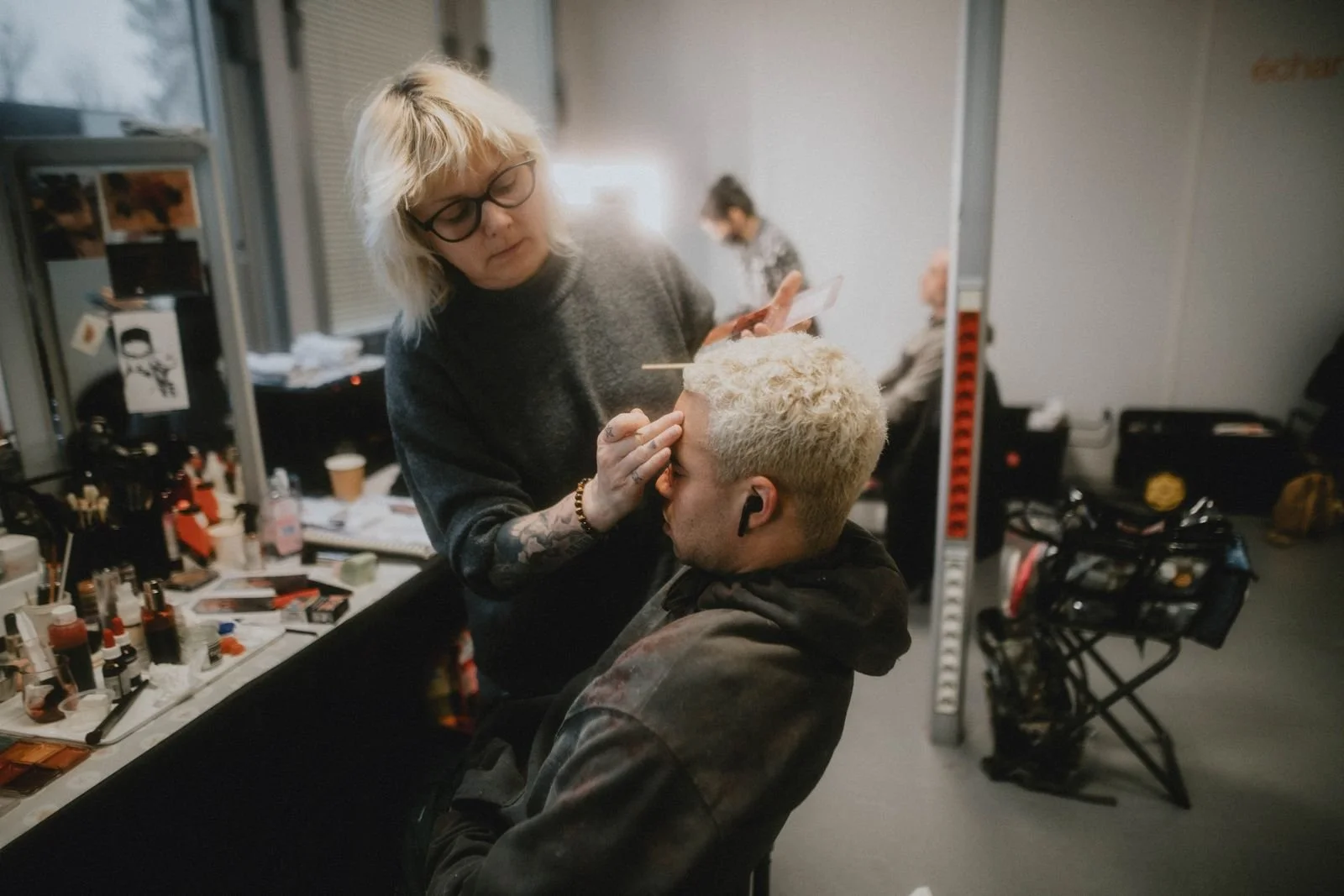
Why Stéphanie Guillon’s Story Matters
About this article: Online Makeup Academy wrote this profile from public sources; it is not an interview with Stéphanie Guillon. Updated October 26, 2026.
When Stéphanie Guillon accepted the Academy Award for Best Makeup and Hairstyling for The Substance at the 97th Oscars in 2025, shared with Pierre-Olivier Persin and Marilyne Scarselli, it capped two decades of work in French and international film. As the film’s key makeup artist she focused on beauty and character makeup; the prosthetic transformations were designed by Pierre-Olivier Persin and his team.
Three Takeaways From Her Journey
Skill > Zip Code. World‑class technique travels further than any passport stamp.
Relationships Are Currency. Film work often comes through referrals, so every set is a chance to build your network.
Learning Never Stops. Even Oscar winners attend masterclasses, and, for the first time, teach them to the public.
Deep‑Dive Biography — Stéphanie’s Journey
Early Life & Beginnings
Born: 14 June 1971, Boulogne‑Billancourt, France
Stéphanie’s Career Milestones
| Year | Project | Role | Notes |
|---|---|---|---|
| 2025 | The Substance | Key Makeup Artist | Beauty and character makeup; Academy Award, shared with Pierre-Olivier Persin and Marilyne Scarselli |
Craft Philosophy
Global Inspiration: Guillon cites Korean pop‑culture sparkle and ‘80s runway color blocking as influences, often mood‑boarding BLACKPINK videos alongside vintage YSL shows.
Practical Over Digital: Prefers on‑camera artistry that reads in 4K without heavy VFX cleanup, one reason directors like Coralie Fargeat fight to secure her on set.
Recognition & Media
Oscar Win: Best Makeup & Hairstyling for The Substance alongside Pierre‑Olivier Persin and Marilyne Scarselli (97th Academy Awards).
Guild Honors: Make-Up Artists & Hair Stylists Guild Award for Best Contemporary Make-Up (feature film) for The Substance, 2025.
Interviews: In Marie Claire, she revealed her creative clashes with director Coralie Fargeat and how Charlotte Tilbury lipsticks survived 11 takes of Demi Moore smearing her own face.
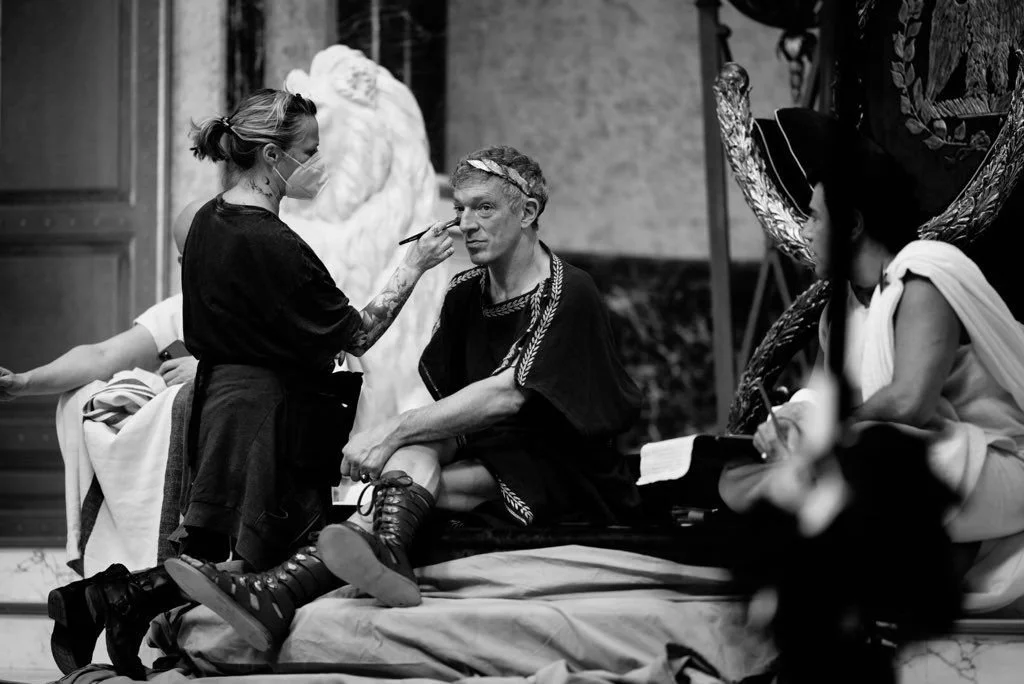
Breaking Into Film & TV Makeup: A Roadmap
Below is a 5‑stage blueprint adapted from Stéphanie’s career arc plus best practices we teach inside our Elite Makeup Course.
| Stage | Goals | Action Steps | Benchmarks |
|---|---|---|---|
| Foundation | Master core techniques | Complete a certified program (e.g., OMA Elite or Master Makeup Program). Build a 20‑look portfolio (beauty + character) | Portfolio ready in 6 months |
| Network | Get on student & indie sets | Volunteer for film‑school shorts. Attend Stage 32 & IATSE mixers | 10 set days logged |
| Assist | Learn set etiquette & pace | Shadow key artists weekly. Offer kit management & continuity photos | Referrals from 2 seniors |
| Specialize | Stand out with niche skills | Prosthetics, HD skin, historical looks. 100-look challenge | 3 niche looks shot in 4K |
| Union & Credits | Become hire‑ready | Track hours for IATSE 706/798. Publish IMDBPro page & portfolio site | Union eligibility + 10 credits |
Related read: How Much to Charge as a Makeup Artist, pricing advice that applies to film day‑rates.
Pro Tips Straight From the Oscar Stage
Prep Over Patch‑Up. 60 % of flawless longevity lies in skin prep.
4K Dailies Check. Always review footage at full resolution to spot micro‑texture.
Continuity Cloud. Share face charts via Google Drive for multi‑unit shoots.
Emergency Mini‑Kit. Pack a puff, blot films, a spatula and micro-brushes for 30-second saves.
Partner With Lighting. Collaborate with the DP; lighting can make or break your masterpiece.

Film‑Set Roles & Etiquette
| Role | Core Responsibility | Pro Etiquette Tip |
|---|---|---|
| Key Makeup Artist | Oversees department vision | Keep open comms with costume & hair to ensure palette harmony |
| Department Head | Budget, scheduling, hiring | Present solutions, not problems—producers love it |
| Makeup Assistant | Supports key, manages kit | Anticipate needs; silent efficiency wins re‑hires |
| Special FX Artist | Prosthetics & wounds | Respect actor comfort—explain removal processes |
Building a Film‑Ready Portfolio
Show Narrative Range: Include beauty, character, aging, and injury looks.
Use Pro Photography: 4K stills on neutral backdrops; include a close‑up + full figure.
Caption Context: Note lighting, products, and your role (key or assist). Producers love clarity.
Host Smart: Display on a custom domain (e.g., yournameMUA.com) + gallery for SEO juice.
Salary & Rate Benchmarks — Film/TV Makeup (2025)
| Role | USA, Union (IATSE 706/798) | USA, Non-Union | Europe, Union (BECTU, ver.di, etc.) | Europe, Non-Union |
|---|---|---|---|---|
| Makeup Assistant | $350 – $500 / day | $250 – $350 / day | €280 – €400 / day | €180 – €300 / day |
| Key Makeup Artist | $600 – $900 / day | $450 – $700 / day | €450 – €700 / day | €350 – €550 / day |
| Department Head | $950 – $1,400 / day | $750 – $1,100 / day | €700 – €1,050 / day | €550 – €850 / day |
Union vs. Non-Union:
• Union productions guarantee overtime, kit rentals, pension/health, and turnaround penalties—rates above exclude those extras.
• Non-union gigs may offer flat “all-in” fees; always clarify overtime and kit reimbursement before you sign.
• Streaming series in the U.S. often follow union rates even when shot abroad, so confirm contract jurisdiction early.
Numbers reflect 2025 averages from production listings, rate cards, and crew diaries across Los Angeles, New York, London, Berlin, and Prague. Actual pay varies with budget tier, location, and genre (commercials often pay higher day rates, while indie features pay lower but longer runs).
Mentorship & Continuous Learning
Mentorship matters early in a career. Here’s how OMA supports it:
Certified Feedback: All students receive personalized video critiques from industry pros.
Alumni Network: 7,000 graduates across 40+ countries—instant peer support.
Diploma: Receive an official Online Makeup Academy diploma to showcase your red-carpet training.
Industry-Approved OMA Kit: Receive our full pro kit—curated and approved for on-set work—so you can practice Stéphanie’s techniques with precision.
Film & TV Makeup FAQ (2025 Edition)
Q1. How many union hours do I need to join IATSE Local 706 (Hollywood) or 798 (NY/Atlanta)?
Generally 30 paid makeup days within a 12-month window on qualifying productions OR placement on a 60-day “roster” if recommended by two active members. Always keep pay stubs and call sheets; digital copies count.
Q2. What’s the best “first camera” for shooting my portfolio?
You can start with a latest-gen smartphone (iPhone 16 Pro or Pixel 9) using natural light + reflector. When you’re ready to level-up, grab an entry-level mirrorless (Canon R50 / Sony α6400) and a 50 mm f/1.8 lens for crisp skin detail.
Q3. Are allergy-safe or cruelty-free products mandatory on set?
Not yet industry-wide, but studios increasingly ask for vegan / fragrance-free options. Keep hypoallergenic basics (silicone-based primers, unscented wipes, latex-free sponges) in your kit—especially for union shows with strict health guidelines.
Q4. How big should my set bag be—and what goes inside?
Aim for a medium “on-set” bag (~12 × 8 × 5 in.) that stays with you at video village. Stock only essentials: translucent powder, touch-up palettes, alcohol spray, tissues, cotton buds, mini-brushes, blot films, and actor-specific shades chart.
Q5. Do I need insurance as a freelance makeup artist?
Yes, most U.S. producers require $1 million general liability plus professional indemnity (aka “errors & omissions”). In the EU, public liability is standard. Many unions offer discounted policies; check member perks.
Q6. How early should I arrive relative to call time?
15–30 minutes before crew call is minimum; department heads often show up 60 minutes early to set stations, review continuity, and sync with hair & wardrobe.
Q7. What’s a typical workday length—and when does overtime kick in?
Union sets book 10-hour base days (plus 1 hour unpaid lunch). Overtime starts after hour 10 at 1.5× rate, hour 12 at 2×. Non-union jobs vary—negotiate overtime terms in writing.
Final Thoughts & Next Steps
Hollywood’s door isn’t locked, it’s guarded by experience, adaptability, and fearless networking. Stéphanie Guillon’s story shows that with the right skills and mentors, you can open it. Ready to make your entrance?
Enroll in our Elite Makeup Course to master fundamentals.
Register for the Stéphanie Guillon Live Masterclass before seats run out.
Stay creative, stay curious—and we’ll see you backstage.