
How to Work With Makeup Clients: A Pro MUA's Complete Guide

Working with makeup clients well comes down to a structured process: a thorough pre-appointment intake, a 5–10 minute in-chair consultation, transparent communication during application, and a clear reveal-and-touch-up protocol at the end. The technique you apply matters, but how a client feels in your chair is what fills your calendar, referrals, repeat bookings, and five-star reviews come from artists who manage the entire client experience, not just the makeup.
Most aspiring MUAs prepare obsessively for the application itself and almost nothing for the conversation around it. That's backwards. A flawless smokey eye doesn't save you from a client who feels rushed, unheard, or unsure if your kit is sanitary. This guide walks through the complete client journey, before, during, and after the appointment, with the exact protocols working professionals use to keep clients confident and coming back.
In this guide, you'll learn:
The pre-appointment intake questions every pro MUA should send before a booking
A consultation framework that prevents 90% of "I don't like it" moments
Industry-standard sanitation practices clients silently judge you on
How to handle difficult clients, look-change requests, and the unhappy reveal
What Does Working With Makeup Clients Actually Involve?
Working with makeup clients involves three distinct phases, pre-appointment, in-chair service, and post-appointment, and each phase has specific deliverables that separate a working pro from a hobbyist. Pre-appointment covers inquiry response, contracts, deposits, and intake questionnaires. In-chair service includes consultation, sanitation, application, and check-ins. Post-appointment covers the reveal, touch-up kit handoff, photo permissions, and follow-up communication that drives reviews and referrals.
The artists who book out months in advance treat each of these phases as a system, not as improvisation. A bride who feels guided through a clear process is a bride who refers her three best friends; a bride who feels like the artist is winging it is a one-and-done booking, even if the makeup was technically flawless. Process is the multiplier on technique.
Why client management is what builds a sustainable MUA business
Working MUAs typically earn between 50% and 80% of their income from repeat clients and direct referrals. That math only works if every client leaves the chair feeling heard, respected, and confident in how they look. Technique gets you the first booking; client experience gets you the next ten. This is why beauty schools that teach only application are training hobbyists, not professionals, the business of being an MUA is fundamentally about service delivery.
Pre-Appointment: What to Do Before the Client Sits Down
The work of being a good makeup artist starts the moment a client first contacts you, not when they arrive at your station. Three pre-appointment systems do most of the heavy lifting: a fast inquiry response, a written agreement, and a detailed intake questionnaire.
Respond to inquiries within 24 hours
Response time is the single biggest predictor of whether an inquiry converts to a booking. Bridal clients especially are usually contacting three to five artists at once; the first organized, professional response often wins the booking even if the artist's portfolio is comparable to the others. Build a saved-reply template you can personalize in two minutes and respond from email, not from Instagram DMs, email creates a searchable record of every agreement.
Use a written agreement and deposit for every booking
A simple contract protects both sides and signals professionalism. Your agreement should include service description, total price, deposit amount (typically 25–50% non-refundable), wedding day timeline (if applicable), travel fees, cancellation policy, and what's included versus extra (lashes, additional looks, touch-up service). Tools like HoneyBook, Dubsado, or even a customized Google Doc with a signature line all work. Never accept a booking on a verbal promise, even from a friend.
Send a pre-appointment intake questionnaire
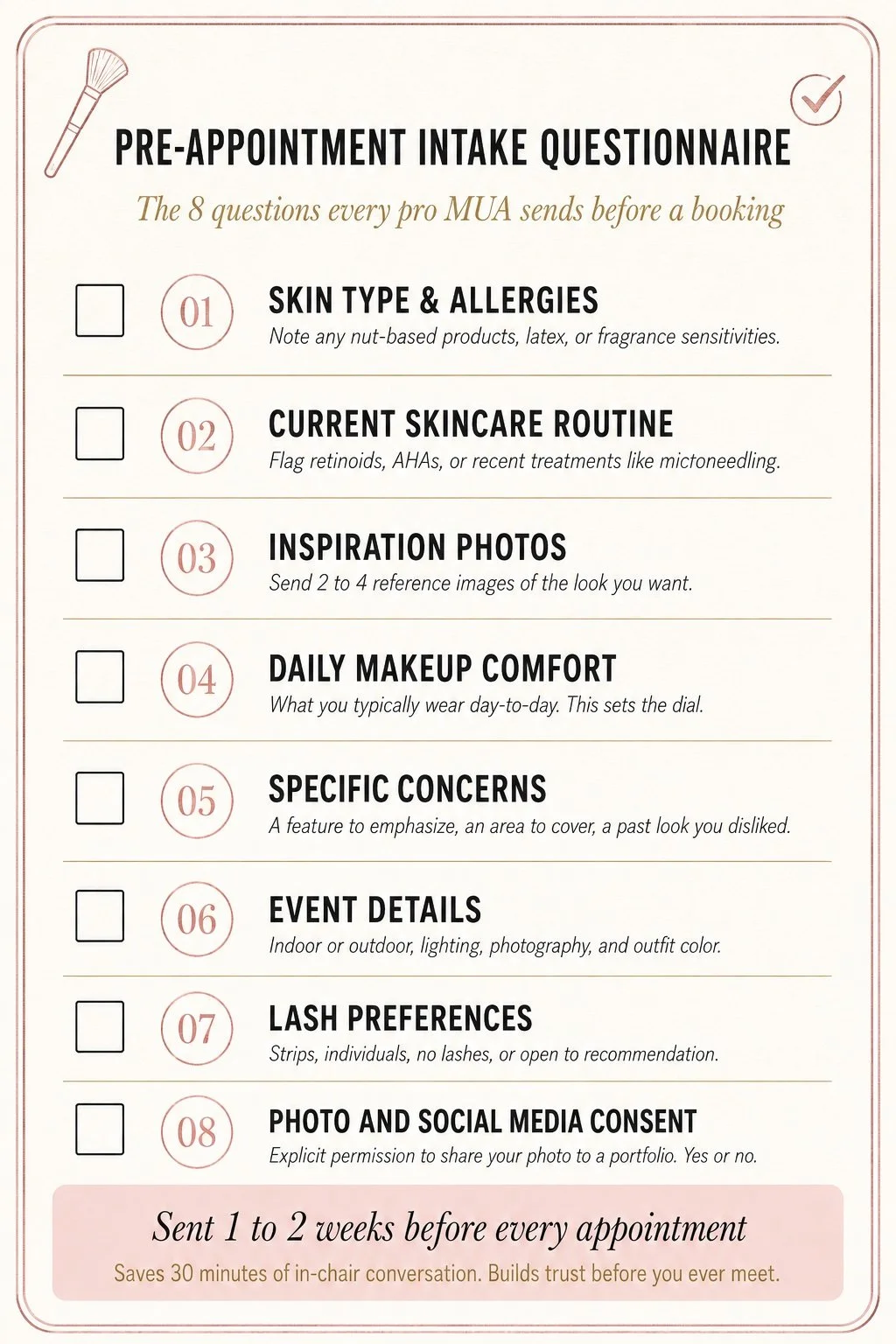
An intake questionnaire (sent 1–2 weeks before the appointment) does in 10 minutes what would take 30 minutes of awkward in-chair conversation. Include these essential questions:
Skin type and any known allergies or sensitivities - especially nut-based products, latex (for lash adhesives), and fragrance
Current skincare routine and any active ingredients - retinoids, AHAs, or recent treatments like microneedling affect makeup application
Inspiration photos - ask for 2–4 reference images of the look they want; "natural glam" means radically different things to different people
What they typically wear daily - this gauges their comfort level with a bolder look
Any specific concerns - a feature they want emphasized, a scar or hyperpigmentation they want covered, a previous makeup experience they didn't like
Event details - indoor or outdoor, lighting conditions, whether they'll be photographed, the dress or outfit color
Lash preferences - strip lashes, individuals, no lashes, or open to recommendation
Photo and social media consent - explicit permission (or not) for you to post their photo to your portfolio
The questionnaire isn't just information gathering, it builds trust before you've ever met in person. A client who fills out an 8-question form feels seen and prepared; an artist who sends one signals "I do this professionally and consistently."
The In-Chair Consultation: A 10-Minute Framework That Prevents Most Problems
Before you touch the client's face, run a structured 5–10 minute consultation. This is where you confirm everything the intake form told you, fill in gaps, and explicitly align on the look you're about to create. Skipping or rushing this conversation is the single biggest source of "I don't love it" moments at the end.
The five questions to ask in every consultation
"Walk me through your inspiration photos.", Ask the client to show you their references and describe what specifically they love about each one. They might love the lip in one, the eye in another, and the skin finish in a third. Drawing this out prevents you from copying a look they only partially wanted.
"On a scale of 1–10, how dramatic do you want to land?", A numerical scale eliminates the ambiguity of words like "natural," "soft glam," or "full glam." A 3 is a different makeup than a 7, and now you both know which one you're doing.
"Are there any features you want me to emphasize, and any you'd rather we play down?", Open-ended phrasing avoids putting words in their mouth. Some clients want bigger eyes; others want a brighter mouth; others want their freckles to show through.
"Any absolute no-gos?", Common ones: heavy foundation, dramatic winged liner, glitter, false lashes, a specific lip color from a previous bad experience. Get these on the table early.
"What's the lighting and photography situation today?", Outdoor harsh sunlight, dim indoor venue, professional flash photography, and natural-window lighting each call for different formulas, especially around SPF and finishing powders.
End the consultation by repeating back your understanding: "So I'm hearing you want a 6/10 soft glam, peachy-warm tones, your freckles visible through the skin, individual lashes not strips, and a satin nude lip. Sound right?" That single sentence prevents most reveal-time disappointments.
Photography and lighting awareness
Always ask whether the client will be photographed and under what conditions. Flashback (the white ghostly look that appears on photographed skin) is caused by specific ingredients, primarily titanium dioxide and zinc oxide found in mineral SPF and some setting powders. For any client being photographed with flash, avoid mineral-SPF-heavy products and switch to non-mineral setting powders. Test with a phone flash before they leave the chair.
Sanitation: The Industry Standard Clients Silently Judge You On
Sanitation isn't optional and isn't a "tip", it's the legal and ethical foundation of professional makeup artistry, and clients increasingly know enough to spot when an artist cuts corners. Following sanitation industry standards protects clients from bacterial infections, conjunctivitis, cold sores, dermatitis, and allergic reactions, and protects your business from liability and bad reviews.
The non-negotiable sanitation protocol between every client
Wash and sanitize your hands in front of the client at the start of the appointment. This is performative on purpose, visible sanitation builds trust.
Spot-clean brushes with brush cleaner or 70% isopropyl alcohol between clients. Deep-clean with brush shampoo at the end of every working day.
Never double-dip. Scoop cream products (foundation, concealer, cream blush, gel liner) onto a sanitized stainless steel palette with a clean spatula. Work from the palette, not the original container.
Use disposables for every wet or mucous-membrane application, mascara wands, lip wands, individual lash applicators, cotton swabs. Never reuse between clients.
Sharpen and alcohol-spray every pencil (eyeliner, lip liner, brow) before each client. This removes the contaminated top layer.
Spray powder products (eyeshadow, blush, bronzer, pressed powder) with 70% isopropyl alcohol and wipe the top layer with a clean tissue between clients.
Avoid felt-tip liquid eyeliners on clients, they cannot be properly disinfected. Use gel liners from a palette with a clean brush, or buy single-use options.
Stock a metal palette, palette knife (spatula), 70% isopropyl alcohol spray, brush cleaner, disposables, and tissues in every working kit.
If a client ever asks how you sanitize between bookings, you should be able to answer with this list in 30 seconds.
How to Handle Difficult Clients and Look-Change Requests
Difficult-client moments fall into three categories: indecisive clients, mid-application change requests, and the unhappy reveal. Each has a specific professional response that protects the relationship and the booking.
For the indecisive client
When a client can't articulate what they want, slow down, don't speed up. Pull up their inspiration photos again and narrow the choice down to two options: "We can go either direction, do you want option A, which is more peachy and soft, or option B, which is more cool-toned and structured?" Binary choices feel manageable when open-ended questions feel paralyzing. Build in 10–15 extra minutes of buffer time for any client who flagged "indecisive" on their intake.
For mid-application change requests
If a client asks for a change halfway through (lighter foundation, different lip color, less eyeliner), acknowledge the request immediately and pivot without visible frustration: "Totally, let's adjust that. Give me one minute to switch products." Most mid-application changes take five extra minutes; making the client feel rushed or judged costs you a referral. The exception: if the request would actively damage the look (asking for orange foundation two shades too light, for example), say so kindly and offer an alternative.
For the unhappy reveal
When a client sees themselves and hesitates or says something negative, do not get defensive. Ask one calm question: "What feels off to you?" Listen completely before responding. Most unhappy reveals come down to one specific element, lip color too dark, blush too pink, eyeliner too thick, and almost all are 5-minute fixes. Adjust the specific element, ask them to look again, and confirm.
If a client is genuinely upset and you can't resolve it in 15 minutes, offer a partial refund or a complimentary touch-up service, and learn from the booking. Document what went wrong in your client notes so the same issue doesn't repeat with a future client.
The Reveal, Touch-Up Kit, and Post-Appointment Follow-Up
The last 10 minutes of an appointment shape what the client remembers about you. A strong reveal, a thoughtful touch-up kit, and a 24-hour follow-up are the three highest-leverage post-application moves.
How to do the reveal
Hand the client a mirror in good lighting and stay quiet for a beat. Let them react first. Then ask: "How are you feeling about the look?" not "Do you love it?", the second phrasing is leading and makes hesitation feel awkward. If they're happy, ask permission for photos; if they're hesitant, return to the unhappy-reveal protocol above.
Build a leave-behind touch-up kit for bridal and event clients
For higher-priced bookings (especially bridal), a small touch-up kit is one of the highest-ROI touches in the entire client experience. Include: their exact lipstick (or a sample-sized version), blotting papers, a disposable mascara wand, a few cotton swabs, and a small mirror in a branded pouch. Production cost is usually $8–$15; client perception of value is significantly higher, and it dramatically reduces the "my makeup smudged at the reception" complaint.
Follow up within 24 hours
Send a short message the next day: "It was such a pleasure doing your makeup yesterday, hope the event went beautifully. If you have any photos you're willing to share, I'd love to see them. And if you have a minute to leave a review on Google or Instagram, it really helps small businesses like mine." This single text or email is responsible for most of the Google reviews working MUAs generate. Reviews compound, every review makes the next booking easier.
Common Mistakes New MUAs Make With Clients
Most client-relationship mistakes come from treating each booking as a one-off rather than as a system. The same five errors show up over and over in early-career MUA work:
Skipping the consultation to save time: Cutting a 10-minute consultation to "get started faster" almost always costs more time at the end, when the client doesn't recognize themselves in the mirror. The consultation is the application's most important step.
Doing makeup in bad lighting: Application under warm yellow indoor light or harsh overhead light produces makeup that photographs and reads completely differently outdoors. Invest in a ring light or daylight-balanced LED panel and bring it to every booking.
Matching foundation only to the face: Skin tone on the face, neck, and chest is rarely identical, especially on clients wearing open-necked outfits. Match the foundation to the neck and chest, not the face, the mismatch is what creates the "floating head" look in photos.
Over-baking on every client: Baking (a technique where setting powder is applied thickly on top of concealer and left to "cook" for several minutes before being dusted off) emphasizes texture on dry, mature, or fine-lined skin. Use it sparingly and skip it entirely on clients over 40 or with visible fine lines under the eye, finely-milled translucent powder pressed in gently sets concealer without exaggerating texture.
Trying new techniques on a paying client: An event day is never the time to test a technique you haven't perfected. Trial sessions exist for experimentation; paid appointments are for delivering reliable work. Practice new looks on friends and family first.
How Online Makeup Academy Trains You for Real Client Work
The technique side of makeup artistry is learnable from any reasonable course, but the business and client-management side is where most beauty programs leave a serious gap. At Online Makeup Academy, our curriculum is built around the full professional workflow: consultation protocols, sanitation practices, pricing conversations, contracts, and the soft skills that turn a single booking into a repeat client.
Our students complete the program with the technical skills and the operational systems to start booking clients with confidence, including templates for intake questionnaires, contracts, and follow-up communication you can use from day one. Explore our Master Makeup Program →
Frequently Asked Questions About Working With Makeup Clients
What should a makeup artist ask a client before the appointment?
A makeup artist should ask about allergies and skin sensitivities, current skincare routine and active ingredients, inspiration photos, daily makeup comfort level, event details and lighting conditions, lash preferences, and explicit photo and social media consent. A written pre-appointment questionnaire sent 1–2 weeks before the booking is the industry-standard way to collect this information.
How do you handle a client who doesn't like their makeup?
Ask one calm, specific question, "What feels off to you?", and listen completely before responding. Most unhappy reveals come down to a single element (lip color too dark, blush too pink, eyeliner too thick) that can be adjusted in five minutes. Do not get defensive; treat the feedback as information, fix the specific element, and confirm before they leave the chair.
What questions do you ask in a bridal makeup consultation?
The five highest-leverage bridal consultation questions are: walk me through your inspiration photos, on a scale of 1–10 how dramatic do you want to land, which features do you want emphasized or played down, are there any absolute no-gos, and what's the lighting and photography situation. End by repeating your understanding back to the client to confirm alignment before applying.
How long should a professional makeup application take?
A standard professional makeup application takes 45–75 minutes, roughly 10 minutes for consultation and skin prep, 30–45 minutes for application, and 5–10 minutes for the reveal and adjustments. Bridal trials typically run 60–90 minutes; wedding-day applications run 45–60 minutes per face. Bridal-party services should be timed at 45 minutes per face when scheduling the morning timeline.
How do makeup artists sanitize between clients?
Professional makeup artists sanitize between clients by washing hands, spot-cleaning brushes with brush cleaner or 70% isopropyl alcohol, scooping cream products onto a sanitized metal palette with a clean spatula (never double-dipping), using disposable wands for mascara and lip products, sharpening and alcohol-spraying every pencil, and spraying powder products with alcohol before wiping the top layer. Industry standards require these protocols for every client, every time, there are no shortcuts.
The Bottom Line
Working with makeup clients well is a system, not a skill, the artists who build sustainable businesses treat the pre-appointment intake, in-chair consultation, sanitation protocol, and post-appointment follow-up as standardized processes they run every single time. Technique gets you the first booking; consistent professional process gets you the next ten, the referrals, and the reviews that compound into a real career. Treat every client as the start of a relationship, not the end of a transaction.
Ready to take your makeup skills to the next level? Explore Online Makeup Academy's programs →
About the Author: The Online Makeup Academy team is led by certified makeup artists and beauty educators with over a decade of professional experience in bridal, editorial, and film makeup. Our instructors have trained thousands of aspiring MUAs in technique, client management, and the business of beauty. | Last updated: May 2026