
How to Improve Your Makeup Skills: A Pro Artist's Guide
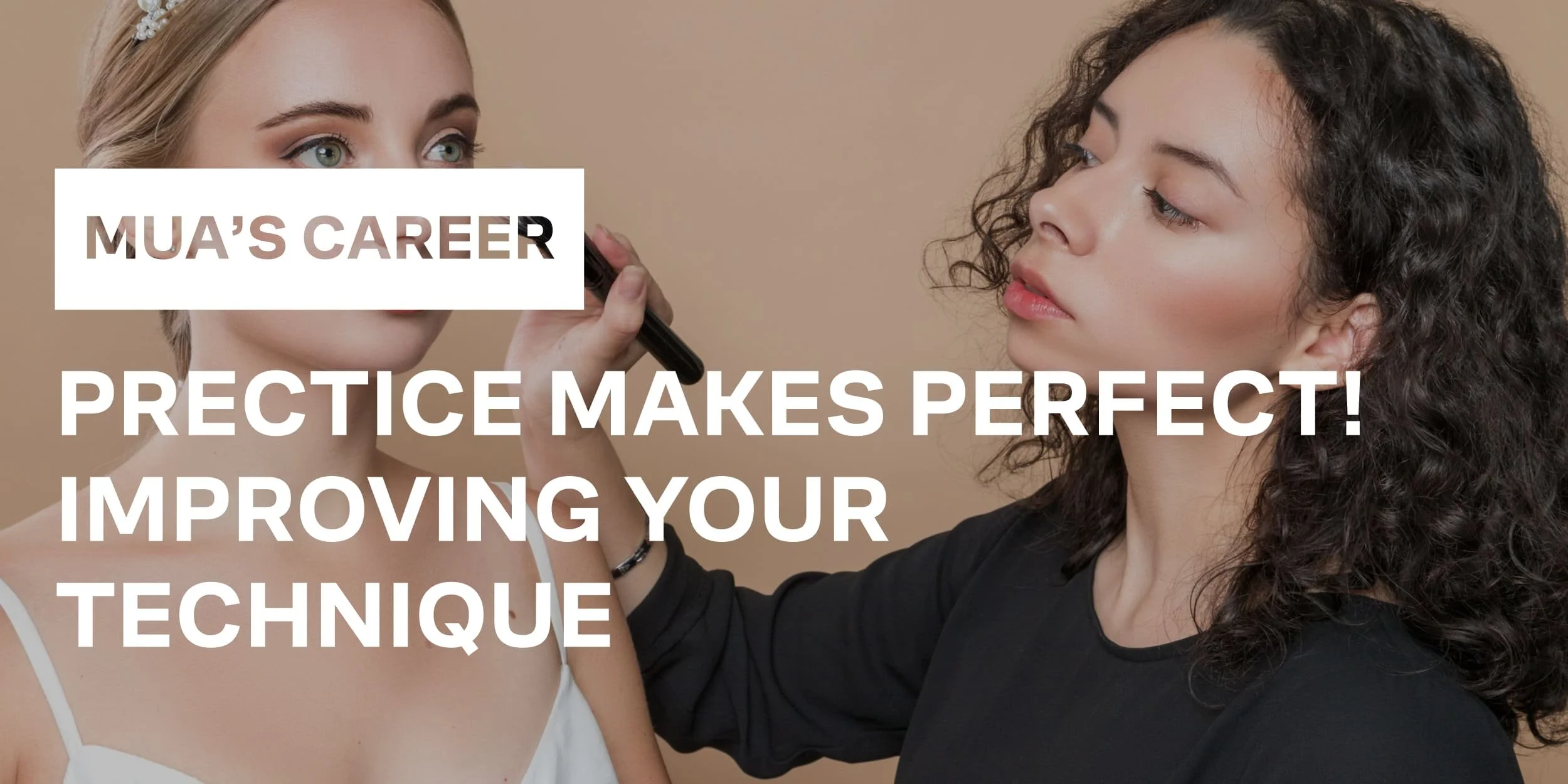
The fastest way to improve your makeup skills isn't watching more tutorials, it's practicing deliberately. Most aspiring artists plateau because they repeat the same looks on the same face (usually their own) without targeted feedback or structured drills. The artists who advance do something fundamentally different: they treat makeup the way musicians treat scales and athletes treat training.
Skill development in makeup follows the same principles as any other craft, specific, focused practice; immediate feedback; and deliberate discomfort. The right framework can take a beginner from basic application to competent professional work in 12 to 18 months of consistent effort. Without it, even talented hobbyists can spend years producing the same level of work.
In this guide, you'll learn:
Why most people plateau and how pros avoid it
The deliberate practice framework applied to makeup artistry
Seven specific drills that build real skill (not just hours)
How to self-critique, break plateaus, and track progress honestly
Why Most People Plateau at Makeup (and How Pros Don't)
The number one reason artists stop improving is that they repeat the same looks on the same face without feedback. Doing a soft glam on yourself every Saturday for a year isn't practice, it's habit. Your hands memorize one set of movements on one face shape, and you stop growing. This is what sports scientists call the "OK plateau", you've become competent enough to function, so your brain stops optimizing.
Professional makeup artists avoid this trap by doing something specific: they constantly introduce new variables. Different face shapes, different skin tones, different lighting conditions, different lip anatomies, different eye shapes. Every session becomes an opportunity to solve a new problem, not execute a familiar one.
The other plateau trap is "tutorial scrolling", watching dozens of hours of content without applying any of it. Watching someone cut-crease isn't practice. Doing five cut-creases on five different eye shapes this week, reviewing the results, and adjusting is practice.
The Deliberate Practice Framework for Makeup
Deliberate practice, a framework popularized by psychologist Anders Ericsson, is the key to elite skill development in any craft, and it maps directly to makeup. Unlike casual practice, deliberate practice has four non-negotiable elements: a specific skill target, full focused attention, immediate feedback, and operating just beyond your current ability.
Applied to makeup, that looks like this: instead of "I'll do my makeup tonight," you work on one specific skill, say, cream blending on hooded eyes. You remove distractions (no TV in the background). You photograph your work under consistent lighting, review it within minutes, and identify exactly what needs correction. You do the look again. Then you try it on a different eye shape.
This is how professional MUAs level up quickly. A working artist doesn't casually do makeup, they run targeted reps on specific skills until those skills become automatic, then move to the next one.
The four elements applied to your next practice session
Pick one skill to work on, not the whole face. Eliminate distractions for the duration. Photograph or video the result. Identify one specific correction. Then do it again.
Seven Practice Drills That Actually Build Skill
The drills below are the structured reps that build real skill faster than open-ended practice. Each targets a specific gap most aspiring artists have, and each can be completed in one to three sessions. Run through them in order the first time. Afterward, cycle back to whichever your weakest area is.
The Same Look on Five Face Shapes. Pick one complete look (a neutral smoky eye with a nude lip is ideal for this drill). Execute it on five different models, round, oval, heart, square, and long face shapes. Photograph each in the same lighting. This forces you to adapt placement rather than repeat a template, which is the core skill separating hobbyists from pros.
The Foundation Match Challenge. Match foundation to five people across a range of skin tones and undertones, including at least two deep skin tones and two with visible undertone shifts (pink, yellow, olive, neutral). Check each match at the jawline in natural daylight. Foundation matching is the skill most frequently cited in professional MUA job interviews and the one most beginners rush.
The Eye Shape Drill. Do the same eye look, a basic blended transition, on monolid, hooded, deep-set, almond, and round eyes. Each shape requires a different placement strategy. After five sessions, you'll have internalized how crease depth and shape dictate shadow placement, which most artists never formally learn.
The Speed Round. Complete a full clean, wearable natural makeup look in 25 minutes. Time yourself. Professional bridal and commercial work is done under tight time pressure; artists who can only work well at a leisurely pace struggle to scale. Aim for 25 minutes, then 20, then 15 as your baseline for a polished natural look.
The Reference Recreation. Pick an editorial makeup look from Vogue, Allure, or a Pat McGrath Instagram post. Recreate it as closely as possible. This trains your eye to see what is happening in a professional look, product placement, finish, color theory, not just the overall vibe. Do this weekly.
The Client Simulation. Have a friend role-play a picky client with specific requests ("I want natural but also glam, I don't like heavy eye, I have sensitive skin"). Execute the brief in 40 minutes. This trains the translation skill between what a client says and what they actually want, the most important skill for paid work.
The Self-Critique Session. Review your last 10 completed looks side by side. Identify the three weakest areas across all of them. Those three are your practice priorities for the next month. Repeat monthly. Most artists never do this, which is why they don't improve.
How to Get Feedback That Actually Makes You Better
Feedback is the element that separates ten years of practice from one year repeated ten times. Without it, you reinforce bad habits. With it, every session compounds. The problem is most aspiring artists either get no feedback or get the wrong kind (supportive friends who say "so pretty!" when your blending is patchy).
The highest-quality feedback is photographic self-review. Photograph every practice look from three angles under consistent daylight-balanced lighting. Review on a larger screen, the phone screen flatters your work. Print the photo if you want to see what's really there. Flaws hide on small screens.
The second tier is peer review. Join an MUA community (r/MakeupAddiction, r/Makeup, local MUA Facebook groups, discipline-specific Discord servers) and post work for critique. Specify you want technique feedback, not compliments. Most artists skip this step because it's uncomfortable, which is exactly why it works.
The highest-leverage feedback is expert instruction. A single one-on-one session with a working MUA who critiques your technique is worth months of self-practice. This is why structured makeup education, with tutors who review your assignments personally, compresses learning time dramatically.
The Books, Archives, and References Every Serious MUA Studies
The best makeup artists read, study archives, and reference industry legends continuously. Trends change; fundamentals don't. The professional literature below forms the technical foundation that elevates artists from competent to distinctive.
Foundational books: Kevyn Aucoin's Making Faces (1997) remains the single most-recommended book in the industry because it teaches transformation principles, not trends. Bobbi Brown's Makeup Manual is the working professional's technical reference. Val Garland's Validated documents decades of editorial work and is a master class in creative direction. Pat McGrath's interviews and campaign work (studied through her Instagram archives) teach an artist how the best in the world actually think.
Runway and editorial archives: Vogue Runway's beauty section, Models.com's beauty archive, and the backstage coverage from Fashion Month across every major season are free masterclasses. Study the work of specific artists, Diane Kendal, Tom Pecheux, Lucia Pieroni, Val Garland, across multiple seasons to understand their signatures.
Applied study: Reading or watching isn't enough. For every book chapter or archive deep-dive, plan one practice session that directly applies what you just learned. Study plus application beats either in isolation.
How to Break Through a Makeup Skill Plateau
If you've been doing makeup for six months or more and your work looks the same as it did three months ago, you're plateaued. This is normal and every artist hits it. The key is to diagnose the specific cause rather than generically "practice more."
The three most common plateau causes are: (1) working on the same face shape repeatedly, (2) relying on the same product set, and (3) never getting external feedback. The fixes map directly: practice on five new faces this month, use products you're unfamiliar with for a full week, and post at least three looks for technical critique somewhere public.
A deeper cause is fundamental gaps. Many self-taught artists reach a ceiling because they skipped color theory, undertone identification, or product chemistry early on. If you can't articulate why a peach corrector neutralizes purple under-eyes, or why cream products layer differently than powders, you have foundational gaps that no amount of practice will fix. Returning to structured education, even briefly, fills these faster than continued self-teaching.
Building a Progress Portfolio (Not Just a Highlight Reel)
A progress portfolio is different from a client portfolio. It documents every look you do, not just your best, with dates, conditions, and notes. This is the single most effective improvement tool most artists never use.
Keep a dated private album (Google Photos, a cloud drive, or a dedicated app). For each look, capture: three angles, the products used, the face shape/skin type worked on, and one sentence on what you'd improve. Review the album quarterly. You'll see patterns you can't see in any single session, persistent issues with crease placement, a recurring foundation-matching blind spot, a tendency to over-contour.
This is also how you stay motivated. Going back to your work from six months ago is sometimes painful, sometimes delightful, and always educational. It's the clearest possible proof that practice is working.
How Long Does It Actually Take to Master Makeup?
Realistic timelines for makeup skill development depend on practice volume and structure, not talent. With consistent, deliberate practice (three to five hours per week, with feedback), most aspiring artists hit the following milestones:
Beginner to competent (3–6 months): You can execute a clean, wearable natural look and a basic smoky eye on your own face and one or two others. This is the level that lets you do makeup for friends' events.
Competent to paid-work ready (12–18 months): You can execute multiple looks on any face shape or skin tone, match foundation accurately, and adapt to client requests in real time. This is the level needed to charge for work professionally.
Paid to advanced / specialized (2–4 years): You've developed a signature, built a portfolio, and specialized in bridal, editorial, film, or SFX. This is where most working artists stabilize.
Advanced to mastery (10+ years): You're shaping trends rather than following them, teaching other artists, and working at the industry's top level. Mastery in any craft takes roughly a decade of focused work, makeup is no different.
Common Mistakes That Slow Down Your Progress
Several habits quietly kill skill progression, even among dedicated practitioners. Identifying and fixing these is often the fastest way to unlock growth.
Practicing only on yourself. You know your face too well. Your practice must include other faces, at minimum five different people in rotation, to build real skill.
Skipping skin prep and foundation matching drills. Most artists want to jump to creative eye looks. The boring fundamentals (prep, base, match) are what separate professional from amateur work on camera.
Buying more products instead of practicing with current ones. A new palette feels like progress but isn't. Work your current kit until you know each product's finish, blend, and longevity intimately.
Avoiding the looks you're bad at. Artists gravitate to what they're already good at. Improvement lives in the looks you avoid, the cut creases that never blend right, the winged liner that's always uneven. Those are your practice priorities.
Measuring hours instead of deliberate reps. Four hours scrolling tutorials isn't four hours of practice. Thirty focused minutes with feedback beats four unfocused hours.
How Online Makeup Academy Helps You Build These Skills Structurally
Structured education compresses the skill-development timeline dramatically because it solves the two biggest self-teaching problems: foundational gaps and lack of expert feedback. At Online Makeup Academy, every assignment is reviewed personally by a working professional MUA, which means every look you submit comes back with technique-level feedback, the exact mechanism that makes deliberate practice work.
Our Master Makeup Program is built around nine submissions progressing from natural to glamour application, each critiqued by your assigned tutor. This one-on-one feedback loop is what separates structured programs from self-teaching via YouTube. For artists targeting a specific specialization, our Bridal Makeup and Hair Course and Special FX Makeup Course go deeper on discipline-specific technique. If you're serious about improving faster than self-practice allows, schedule a free call to find the right program.
Frequently Asked Questions About Improving Makeup Skills
What's the best way to practice makeup as a beginner?
The best way to practice makeup as a beginner is structured deliberate practice on multiple faces, not repeated casual practice on your own. Pick one skill per session (blending, foundation matching, or liner), practice it on at least three different people over the month, photograph every session for review, and correct based on what you see. This builds real skill faster than open-ended experimentation.
Why am I not improving at makeup even though I practice?
The most common reason artists don't improve despite practicing is that they repeat the same looks on the same face without feedback. Real improvement requires varying the face, getting external critique on technique, and targeting specific weaknesses rather than doing full faces repeatedly. If your practice doesn't include different models and structured feedback, you'll plateau.
How long does it take to become good at makeup?
With consistent, deliberate practice (three to five hours per week with feedback), most aspiring artists reach competent everyday skill in three to six months, paid-work-ready skill in 12 to 18 months, and specialized professional skill in two to four years. Mastery takes roughly a decade of focused practice, consistent with other artistic disciplines.
Can you become a professional makeup artist without school?
Yes, some successful MUAs are self-taught, but the path is significantly longer and more uneven. Structured makeup education compresses learning time by providing fundamentals (color theory, product chemistry, sanitation, client consultation) and expert feedback that self-teaching usually misses. Most working professionals either attend school or invest heavily in mentorship-based learning.
What should I practice first to improve my makeup skills?
Start with skin prep and foundation matching before anything else. These fundamentals determine how professional your work looks on camera and in real life, no amount of great eye makeup compensates for a bad base. After that, focus on blending (cream and powder) and basic color theory. These three areas are the foundation of every advanced technique.
The Bottom Line
Improving your makeup skills is a methodology problem, not a talent problem. Deliberate practice with specific drills, photographic self-review, external feedback, and honest progress tracking will move you forward faster than any product purchase or tutorial binge. The artists who level up quickly treat makeup like a craft that rewards structured effort, because it is.
Ready to accelerate your growth with expert-led feedback on every look? Explore Online Makeup Academy's programs →
About the Author: The Online Makeup Academy editorial team is composed of licensed makeup artists, beauty educators, and industry professionals with decades of combined experience training working MUAs across bridal, editorial, film, and commercial makeup. Our curriculum is taught by instructors actively working in the industry. | Last updated: April 2026