
Must-Have Makeup Brushes: A Pro MUA's Complete Guide (2026)

The must-have makeup brushes every kit needs come down to seven core tools: a beauty sponge or foundation brush, a powder brush, an angled blush or contour brush, a dense buffing brush, a fluffy blending brush, a flat shader brush, and an angled brow brush. Add a small concealer brush and an eyeliner brush and you have a complete kit that handles 95% of everyday looks, for around $50 in drugstore options or $150–$200 in mid-tier pro brands.
The bigger question isn't which brushes to buy, it's which formula each brush is meant for. Synthetic bristles for cream and liquid products, natural bristles for powders, and a handful of dual-use brushes that work across both. Get this matching right and even an affordable brush set delivers professional results. Get it wrong and a $40 brush will streak as badly as a $4 one.
In this guide, you'll learn:
The 7 essential brushes every beginner needs, with named picks at drugstore, mid-tier, and pro prices
5 brushes to add as your skills grow
Natural vs synthetic, and which to use for what
How working MUAs clean and sanitize brushes between clients
Why the Right Brushes Matter More Than the Right Makeup
Quality brushes do three things mediocre brushes cannot: distribute pigment evenly, blend product into skin instead of sitting on top of it, and hold their shape through hundreds of washes. A $4 drugstore foundation applied with the right brush often outperforms a $50 foundation applied with a cheap shedding one. Working makeup artists know this, most pro kits are stocked with budget-friendly products and a small selection of brushes the artist genuinely trusts.
The myth that you need 30+ brushes to do professional makeup is exactly that, a myth, and one we covered in detail in our makeup misconceptions guide. A working MUA's everyday kit is typically 10–15 carefully chosen brushes that handle every face shape and skin type that sits in the chair.
Natural vs synthetic - the only rule that matters
The single most useful thing to know about brushes is which fiber type pairs with which product. Synthetic bristles (nylon, Taklon, polyester) work best with cream and liquid products, foundation, concealer, cream blush, gel liner, because the smooth fibers don't absorb the formula. Natural bristles (goat, squirrel, pony) work best with powder products because their natural cuticle structure picks up and releases pigment evenly across the skin.
Use a natural-hair brush with cream foundation and the brush will soak up the product and streak. Use a synthetic brush with powder eyeshadow and the pigment won't blend as softly. This isn't a preference, it's how the fibers physically behave. The brush list below specifies the right bristle type for each one.

The 7 Essential Makeup Brushes Every Kit Needs
These seven brushes will get you through everyday looks, special occasions, and the foundation of any pro kit. Buy these first, master them, then expand.
1. A beauty sponge (or flat foundation brush)
What it does: Distributes and blends liquid or cream foundation for an airbrushed finish. A damp sponge gives a sheer, dewy look; a dense flat synthetic brush gives more coverage.
Pro picks at every tier:
Drugstore (~$8): Real Techniques Miracle Complexion Sponge
Mid-tier (~$20): Beautyblender Original
Pro flat foundation brush (~$30): Sigma F80 Flat Kabuki
How to use it: For sponges, dampen with water and squeeze out excess until it's spongy, not soaked. Bounce-and-press the foundation into skin rather than dragging. For flat brushes, work in short circular buffing motions, not strokes.
2. A small concealer brush
What it does: Places concealer precisely under the eyes, over blemishes, and around the nose. A flat synthetic brush gives the best control for targeted application.
Pro picks:
Drugstore (~$5): e.l.f. Small Precision Brush
Mid-tier (~$15): Morphe M512 Pro Pointed Blender
Pro (~$28): MAC 195 Concealer Brush
Bristle type: Always synthetic for concealer, natural bristles absorb the cream formula and waste product.
3. A fluffy powder brush
What it does: Sets foundation with translucent powder, dusts setting powder for photography, or applies bronzer for a soft all-over warmth. Slightly smaller is better than larger, small brushes give more control across different face shapes.
Pro picks:
Drugstore (~$10): Real Techniques Powder Brush
Mid-tier (~$22): Morphe M501 Pro Round Powder
Pro (~$45): MAC 134 Large Powder Brush
Bristle type: Natural hair (goat) gives the softest finish for powder. Synthetic powder brushes work but lay product slightly more densely.
4. An angled blush or contour brush
What it does: Places powder blush, bronzer, or contour exactly along the cheekbone. The angled shape mirrors the natural angle of the cheek, which is why pros reach for it constantly.
Pro picks:
Drugstore (~$8): e.l.f. Angled Blush Brush
Mid-tier (~$14): Morphe M519 Pro Sculpting Fan
Pro (~$35): MAC 168 Large Angled Contour
Pro tip: Use the same angled brush for both bronzer and blush, wipe excess product on a clean tissue between uses. This is exactly the multi-use approach working pros use to keep kits lean.
5. A dense buffing brush
What it does: Buffs foundation for full coverage, blends cream products into skin, or applies bronzer for a more sculpted finish. The density gives you control that fluffier brushes don't.
Pro picks:
Drugstore (~$9): Real Techniques Expert Face Brush
Mid-tier (~$22): Morphe E36 Pointed Powder/Blush
Pro (~$28): Sigma F80 Flat Kabuki (yes, it's that versatile)
Bristle type: Synthetic for cream foundations; can go either way for powder bronzer.
6. A fluffy blending brush (eye)
What it does: Diffuses eyeshadow at the crease and outer corner, the brush that prevents harsh lines and creates the soft, blended eye looks that read as professional. If you only buy one eye brush, buy this.
Pro picks:
Drugstore (~$4): e.l.f. Blending Eye Brush
Mid-tier (~$10): Morphe M433 Pro Firm Blending
Pro (~$35): MAC 217 Blending Brush, the single most-cited brush in working MUA kits
Bristle type: Natural hair (goat) blends powder eyeshadow most softly. The MAC 217 is the industry standard for a reason.
7. A flat shader brush (eye)
What it does: Packs eyeshadow color directly onto the lid. The flat, dense shape deposits pigment with intensity that fluffy brushes can't.
Pro picks:
Drugstore (~$4): e.l.f. Eyeshadow Brush
Mid-tier (~$8): Morphe M167 Pro Flat Shader
Pro (~$25): MAC 239 Eyeshade Brush
Bristle type: Natural for powder shadows, synthetic for cream shadows. If you use both, own one of each, they're inexpensive.
5 Brushes to Add as Your Skills Grow
Once you've mastered the core seven, these five expand your range without bloating your kit. Add them as your work demands them, not preemptively.
8. An angled brow brush with spoolie
A dual-ended angled brush (one side stiff angled bristles, the other side a spoolie) is the workhorse for filling and grooming brows. Picks: e.l.f. Wow Brow Gel brush (~$5), Anastasia Beverly Hills Brow Wiz spoolie (~$7), or any dual-ended pro angled brow brush from MAC or Morphe.
9. A precision eyeliner brush
A small angled or fine-tipped synthetic brush for applying gel liner or detail work. Picks: e.l.f. Small Angled Eyeliner Brush (~$3), Morphe M433 Pro Firm Angle Liner (~$8), MAC 263 Small Angle Brush (~$22).
10. A pencil brush for the lower lash line
A small dense pointed brush for smudging eyeshadow along the lower lash line, applying inner-corner highlight, or detailing the outer V of the eye. Picks: Morphe M154 Detail Crease (~$8), MAC 219 Pencil Brush (~$28).
11. A dense crease brush
A small, slightly tapered brush for placing deeper shadow color directly into the crease with precision, distinct from the fluffy blending brush in #6, which diffuses rather than places. Picks: Morphe M330 Blending Crease (~$8), MAC 224 Tapered Blending Brush (~$32).
12. A small lip brush
A flat synthetic brush for precise lipstick application on clients, required for sanitary application of color from a palette or tube. Working pros use disposable lip wands for sanitation, but a quality lip brush is essential for detailed work and ombré lip techniques. Picks: e.l.f. Lip Defining Brush (~$3), MAC 316 Lip Brush (~$22).

Specialty Brushes Working Pros Use
For working MUAs and advanced students, a few specialty brushes round out a full pro kit:
Fan brush: For sweeping away fallout, applying highlighter, or dusting setting powder lightly. Real Techniques Fan Brush (~$10), MAC 187 Duo Fibre (~$45).
Duo fibre stippling brush: For sheer, airbrushed foundation application or cream blush over foundation without disturbing the base. MAC 187 is the industry standard.
Small detail brush: For inner-corner highlight, brow concealing, or precise color correction work.
Flat definer brush: A small flat synthetic brush for placing eyeshadow into the lower lash line, the cleanest way to apply darker color close to the lashes.
Soft tapered powder brush: For setting under-eye baking powder gently without disturbing concealer.
You don't need all of these to work professionally. Add them when a specific look or client need calls for one, not because they're trendy on social media.
Brush Sets vs Building Piecemeal
Working MUAs are split on whether to buy a brush set or build piecemeal, both approaches have merit, and the right answer depends on where you are in your journey.
Brush sets work well if you're a beginner who wants a complete starting kit without research overwhelm, or you want a coordinated travel set. The Morphe Set 690 (~$50) is a 15-brush professional set that working artists genuinely use, and Real Techniques Everyday Essentials (~$25) is a strong drugstore-tier option.
Building piecemeal works better if you already know your application style, you want to mix tiers (drugstore for some, pro for others), or you have specific brushes you've identified as critical. Most working pros eventually move to piecemeal because you can replace individual brushes as they age out, sets force you to buy 15 brushes when you only need to replace one.
For a complete starter kit budget that integrates affordable brushes with a full professional makeup kit, see our $300 pro kit guide, it walks through how to build the whole thing including brushes for under $300.
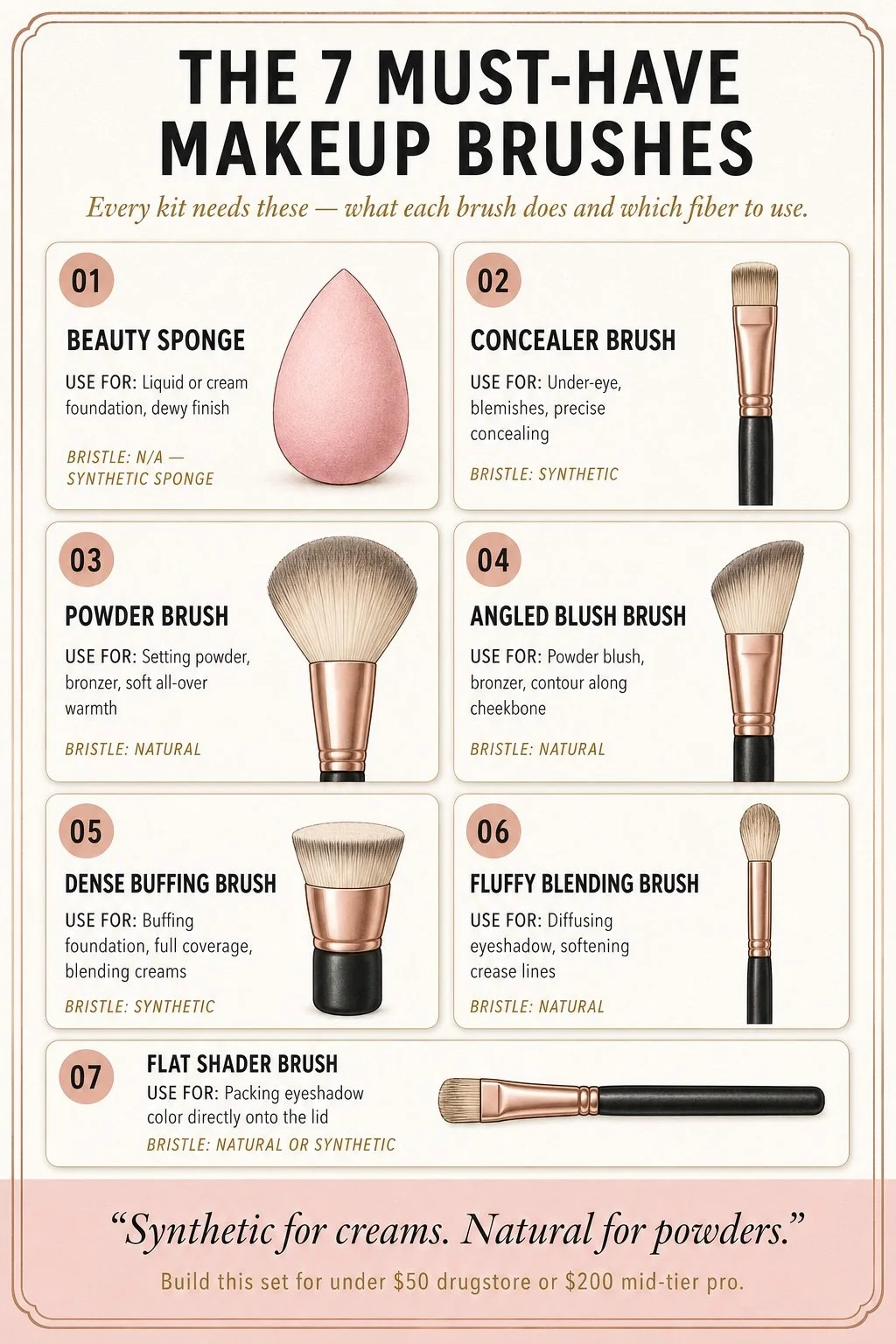
The 7 Must-Have Makeup Brushes
Every kit needs these
How to Clean and Care for Your Makeup Brushes
Brush care is one of the most-skipped steps in beginner kits, and one of the fastest ways to ruin both your brushes and your application. Proper care extends brush life from months to years and prevents the bacterial buildup that causes breakouts, eye irritation, and infections.
The professional cleaning routine
Spot clean between uses (or between clients): Spray 70% isopropyl alcohol or a professional brush cleaner (Cinema Secrets, Beauty Blender Solid) on the bristles, swirl on a clean paper towel until product comes off. Let dry 1–2 minutes before reusing.
Deep clean weekly (or more): Run brushes under lukewarm water with bristles pointing down, never let water enter the ferrule (the metal band), or the glue will loosen and the brush will shed. Swirl in a gentle cleanser (baby shampoo, Dr. Bronner's Castile soap, or dedicated brush shampoo) until water runs clear. Rinse, gently squeeze excess water, reshape the bristles, and lay flat to air dry with the brush head hanging slightly off a counter edge.
Never: Use hot water, soak brushes upright in a cup of water, dry vertically, or use a hairdryer. All four damage the bristles and the glue.
Frequency by brush type
Foundation, concealer, cream-product brushes: Spot clean after every use; deep clean weekly
Powder, blush, bronzer brushes: Spot clean weekly; deep clean every 2 weeks
Eye brushes: Spot clean weekly; deep clean every 2 weeks
Beauty sponges: Clean after every use; replace every 3 months
All brushes used on clients: Spot clean between every client, deep clean at end of every working day
For the full sanitation protocol used between clients, disposables, palette knives, alcohol spraying, hand hygiene, see our working with clients guide, which covers the industry-standard protocols clients silently judge you on.
When to replace a brush
Even well-cared-for brushes don't last forever. Replace a brush when bristles permanently splay outward, the brush sheds significantly after washing, the ferrule starts to loosen from the handle, or the bristles feel rough no matter how much you condition them. A quality natural-hair brush can last 5–10 years with proper care; a synthetic typically 2–5 years; a beauty sponge 3 months maximum.
How Online Makeup Academy Teaches Brush Technique
Knowing which brushes to buy is only half the equation, knowing the precise technique each brush calls for is what separates amateur application from professional results. At Online Makeup Academy, our curriculum covers brush selection, hand positioning, pressure, and the application techniques specific to each tool, from the MAC 217 windshield-wiper blending motion to the angle that makes a contour brush actually contour.
Our students graduate with a complete professional brush kit included with their program, plus the technical training to use every piece of it. If you're still deciding which education path fits your goals, our online vs in-person makeup school guide walks through the differences. Explore our Master Makeup Program →
Frequently Asked Questions About Makeup Brushes
What makeup brushes do you actually need as a beginner?
A beginner needs seven core brushes: a beauty sponge or foundation brush, a small concealer brush, a fluffy powder brush, an angled blush or contour brush, a dense buffing brush, a fluffy blending brush for eyes, and a flat shader brush. This complete starter set can be built for around $50 in drugstore options (e.l.f. and Real Techniques) or $150–$200 in mid-tier pro brands (Morphe, Sigma).
Natural vs synthetic makeup brushes: which should you choose?
Use synthetic bristles for cream and liquid products (foundation, concealer, cream blush, gel liner) because the smooth fibers don't absorb the formula. Use natural bristles (goat, squirrel) for powder products because their cuticle structure picks up and distributes pigment evenly. Most working pros own both types and match the brush to the formula.
How often should you clean makeup brushes?
Spot-clean foundation and concealer brushes after every use with alcohol or a quick-dry cleaner; deep clean them weekly with brush shampoo or baby shampoo. Powder and eye brushes need spot cleaning weekly and deep cleaning every two weeks. For brushes used on clients, spot clean between every client and deep clean at the end of every working day, this is non-negotiable for hygiene.
Are expensive makeup brushes worth it?
Sometimes yes, often no. Quality natural-hair brushes from brands like MAC, Hakuhodo, and Sigma genuinely last 5–10 years with proper care, making the per-use cost very low. But many drugstore brushes from e.l.f. and Real Techniques perform comparably for everyday use. The smartest pro kits mix tiers, drugstore for high-turnover items, premium for the workhorse brushes used daily.
What's the difference between a beauty sponge and a foundation brush?
A damp beauty sponge gives sheer, dewy, skin-like coverage by pressing foundation into skin. A foundation brush (flat or buffing) gives more controlled coverage that can be built up to full. Most working MUAs use both, sponges for natural skin-tint finishes, brushes for more structured complexion work. Sponges absorb significantly more product than brushes, so use less foundation than you would with a brush.
The Bottom Line
The must-have makeup brushes for any kit, beginner or pro, are seven essential tools that pair the right bristle type with the right product category. Buy them once, take care of them properly, and they'll outlast every product in your kit. Add specialty brushes as specific techniques call for them, not preemptively. The professionals you admire aren't using more brushes than you, they're using the right ones, kept clean, with technique earned through practice.
Ready to take your makeup skills to the next level? Explore Online Makeup Academy's programs →
About the Author: The Online Makeup Academy team is led by certified makeup artists and beauty educators with over a decade of professional experience in bridal, editorial, and film makeup. Our instructors have trained thousands of aspiring MUAs in technique, tools, and the business of beauty. | Last updated: May 2026